
Introduction
Imagine that your phone is almost out of battery while you are at an airport, restaurant, shopping mall, hotel, or music festival. You still need your phone for navigation, mobile payment, messaging, e-tickets, photography, or ride-hailing, but you do not have a charger and cannot wait beside a wall socket.
This is where a cell phone charging station creates value.
Users can find a nearby device, complete payment, take out a portable charger, and continue using their phones while moving. For operators, this simple user experience becomes a scalable power bank rental business covering restaurants, cafés, bars, hotels, hospitals, airports, shopping malls, tourist attractions, and event venues.
The business is often misunderstood as selling power banks. In reality, its core is building a location-based portable charging network. Operators deploy rental stations at suitable venues, connect them with payment channels and software systems, and earn revenue whenever users rent a power bank.
A complete business therefore includes more than hardware. It combines:Rental stations and portable power banks,Local payment methods, User rental interfaces, SaaS operation software,
Venue development,Customer service and maintenance,Local branding and pricing.
When these elements work together, shared charging becomes a sustainable rental service rather than a one-time hardware sale.
1. What Is the Shared Power Bank Business?
The shared power bank business is a model in which operators deploy smart rental stations and allow users to rent portable chargers on demand.
From the user’s perspective, it is an instant charging service.
Users do not need to buy or carry a charger in advance. When their battery is low, they find a nearby station, scan a QR code, tap with NFC, pay by card, or use a local electronic wallet. The station releases an available power bank, which the user can carry while shopping, dining, travelling, or attending an event.
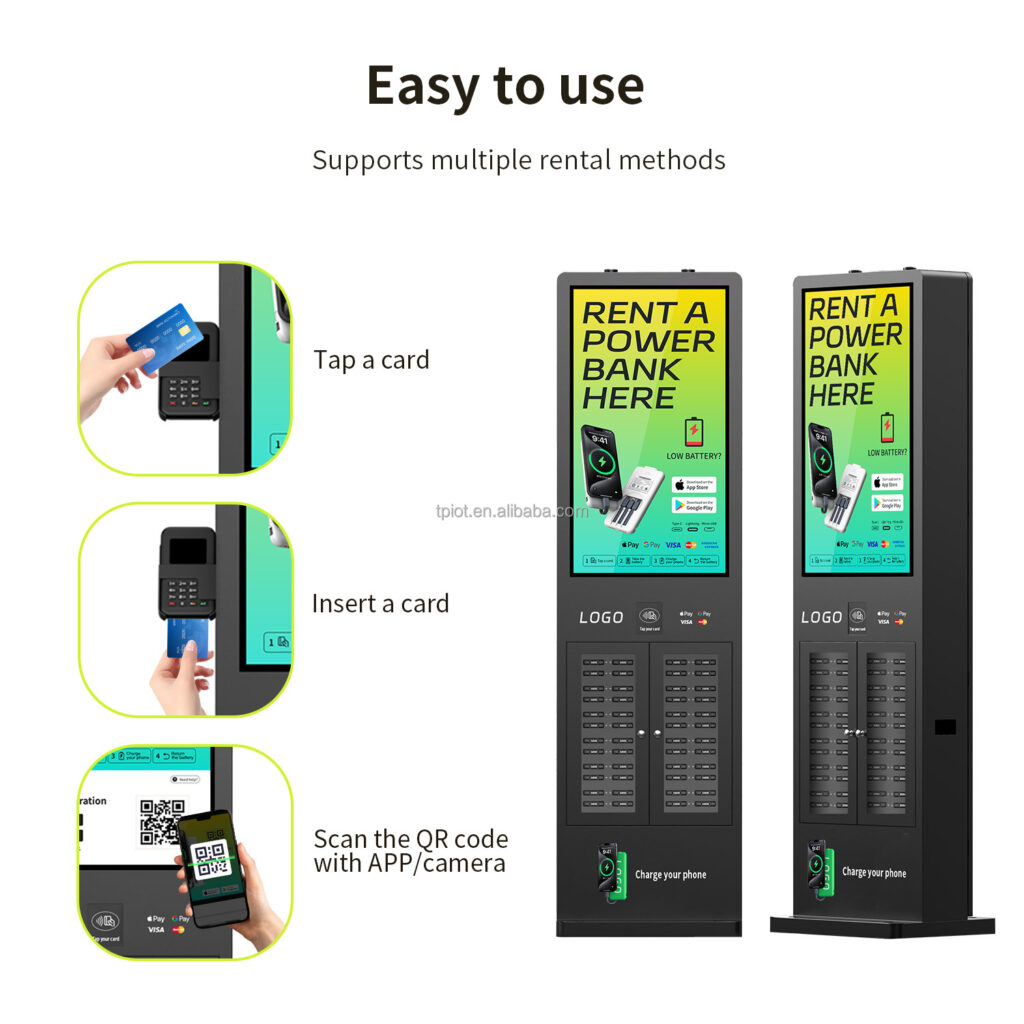
After charging, the user returns the power bank to the same station or another compatible station. The system calculates the fee according to rental time, daily limits, overtime rules, or other pricing settings.
From the operator’s perspective, the business is a local rental network.
Each station is a revenue point, each venue is a traffic entrance, and each rental creates transaction and operation data. As operators deploy more stations and improve location density, users find it easier to rent and return power banks. This can increase usage frequency and strengthen the value of the entire network.
A phone charge station should therefore not be evaluated only by its purchase price. Operators must also consider whether it can operate reliably, support local payments, connect to a stable backend, and scale across hundreds or thousands of locations.
The real business is not the individual machine. It is the network created by devices, venues, payments, software, and local operations.
2. How Does the Business Work?
The basic process can be summarized as:User demand → Find a station → Complete payment → Rent → Charge while moving → Return → Automatic billing
Step 1: The user needs power
Demand usually appears when users are away from home and depend heavily on their phones. Common scenarios include airports, railway stations, shopping malls, restaurants, bars, hotels, hospitals, tourist attractions, exhibitions, and music festivals.
Step 2: The user finds a visible device
Operators place stations in locations where they are easy to notice and use, such as:Restaurant cashier counters, Hotel reception areas, Airport waiting zones, Shopping mall service desks, Bar entrances, Hospital lobbies, Exhibition registration areas,Tourist attraction entrances.
Visibility directly affects rental conversion. Even a high-quality device may generate few orders if it is hidden in a corner.
Step 3: The user completes payment
Depending on the local market, users may rent through:QR code payment, NFC tap-to-rent, Credit or debit card, Apple Pay or Google Pay, Local mobile wallets, A branded app or H5 webpage
Payment success is one of the most important parts of the rental journey. If the station does not support familiar local payment methods, users may abandon the transaction.
Step 4: The station releases a power bank
After payment or pre-authorization succeeds, the system selects an available slot and releases a charged power bank. The user takes it out and charges while moving.
Step 5: The user returns the power bank
The user inserts the power bank into an available slot at the same station or another supported location. The system confirms the return and stops billing automatically.
Step 6: The backend records the transaction
The operation platform records:Rental time, Return time, Order amount, Payment status, Device status, Station revenue, Power bank inventory, Fault alerts, Venue performance.
Operators can also share revenue with venues, agents, or franchise partners according to predefined rules.
For users, the process appears simple. Behind it is an automated system connecting hardware, payment, billing, device management, and revenue settlement.
3.Who Is Involved in the Business?
A shared charging network normally involves six main participants.
Users
Users create demand. They may be tourists, office workers, students, business travellers, shoppers, nightlife customers, hospital visitors, or event participants.
Their need is straightforward: they want immediate access to power without interrupting their activities.
Operators
Operators own or manage the local business. Their responsibilities usually include: Selecting the target market, Purchasing or customizing equipment, Developing venue partnerships, Setting rental prices, Managing payments and settlements, Monitoring devices, Handling maintenance, Providing customer support, Expanding the network.
The operator’s location strategy and execution capability often matter more than the number of machines purchased at the beginning.
Venue owners
Venue partners provide installation space and customer traffic. Typical partners include restaurants, shopping malls, hotels, bars, hospitals, airports, universities, gyms, stadiums, and event organizers.
In return, the venue may receive: A percentage of rental revenue, Fixed rental income, Free charging services for customers, Advertising exposure, Improved customer experience
Hardware suppliers
Hardware suppliers provide stations, power banks, charging modules, lock systems, screens, NFC modules, QR scanners, POS terminals, and accessories.
The hardware affects rental success, return accuracy, online stability, maintenance frequency, and long-term operating costs.
Software providers
Software providers supply the user interface and operation platform. Important functions include:Device monitoring, Order management, Billing rules, Revenue reports,Merchant management, Agent management, Revenue sharing, Fault alerts, Advertising control, Data analysis. Without a stable software platform, managing a large network becomes difficult.
Payment service providers
Payment providers handle authorization, deductions, refunds, settlement, and compliance.This role is especially important for international operators because payment habits differ by country. A system that works well in one market may not fit another market without local card acquiring, wallets, currencies, and tax processes.
4. How Does the Business Make Money?
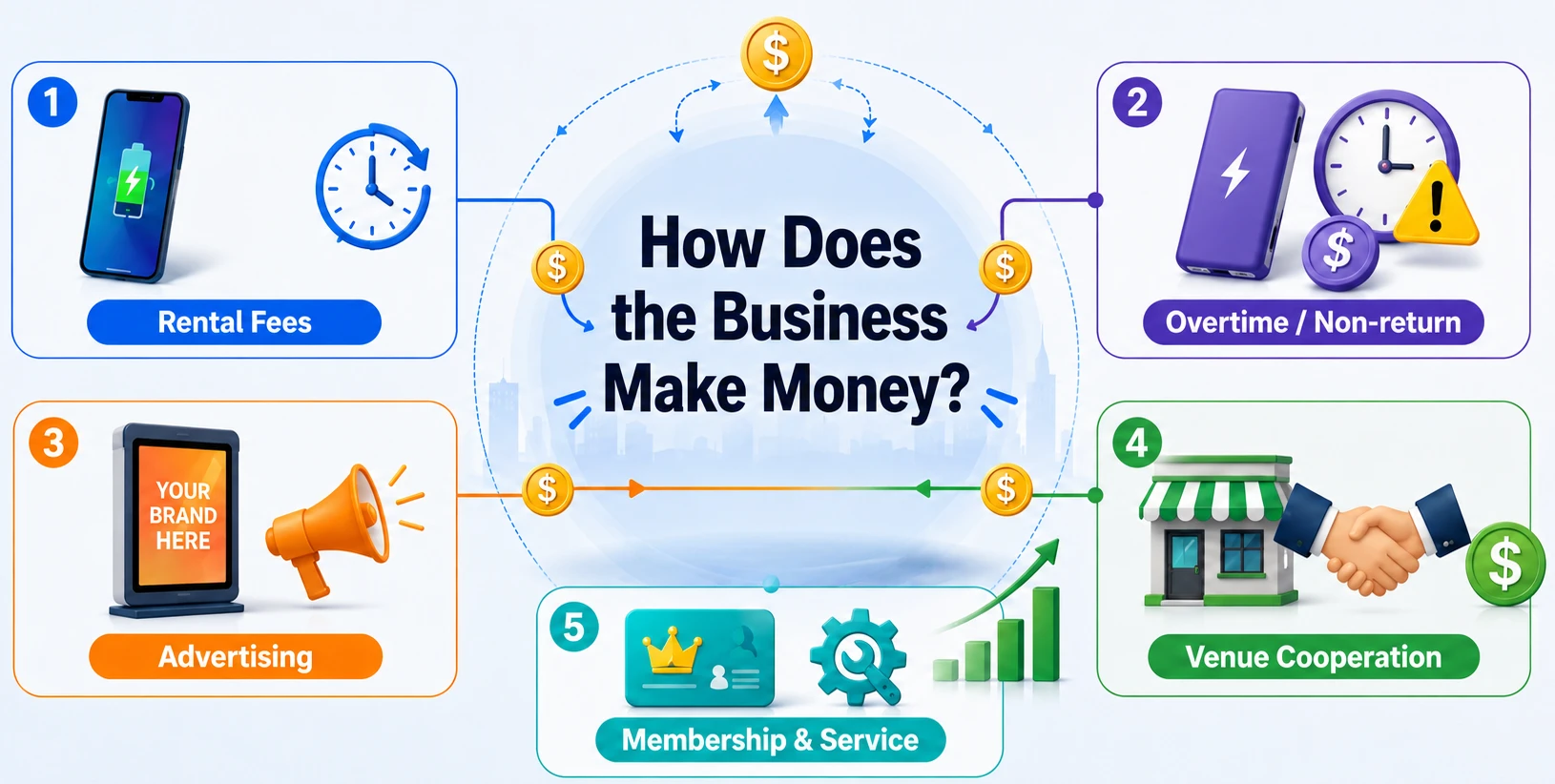
The main source of income is rental revenue, but mature operators can build several revenue streams.
Rental fees
Users pay according to time or usage rules. Common pricing models include:Per-minute pricing, Hourly pricing, Fixed per-use pricing, Daily maximum charges, Different prices for different venues, Rental fees are usually the core revenue source.
A station placed at a location with real demand can generate recurring orders. However, operators must calculate net income after payment fees, venue commissions, maintenance, customer service, and power bank loss.
Overtime or non-return charges
If a user keeps a power bank beyond the normal rental period, the system may continue billing until a maximum fee is reached.
Some markets use deposits or card pre-authorization to reduce losses. Others prefer deposit-free models to simplify the user experience. The appropriate model depends on local payment infrastructure and customer habits.
Advertising revenue
A power bank kiosk with an advertising screen can display:Brand promotions, Venue advertisements, Event schedules, Local merchant offers, Public information, Operator campaigns
Advertising is particularly suitable for airports, shopping malls, hotels, hospitals, tourist attractions, exhibitions, and nightlife venues.
Large-screen stations can combine charging demand with digital media value, creating an additional income source beyond rentals.
Venue cooperation
Venue cooperation affects profit structure. Common models include: Percentage-based revenue sharing, Fixed monthly placement fees, Minimum guarantee plus commission, Free equipment placement, Joint advertising cooperation
Operators should select a model based on expected rental volume, venue value, local competition, and expansion strategy.
Membership and service fees
In hotels, clubs, gyms, office parks, schools, communities, and premium venues, shared power banks can be offered as a member benefit.
Operators may charge the venue for: Equipment rental, Software service, Customized branding, Membership integration, Maintenance services
The business therefore does not depend on one income source. Rental fees, advertising, venue partnerships, memberships, and service fees can form a broader revenue structure.
5. Why Do Users Rent Shared Power Banks?
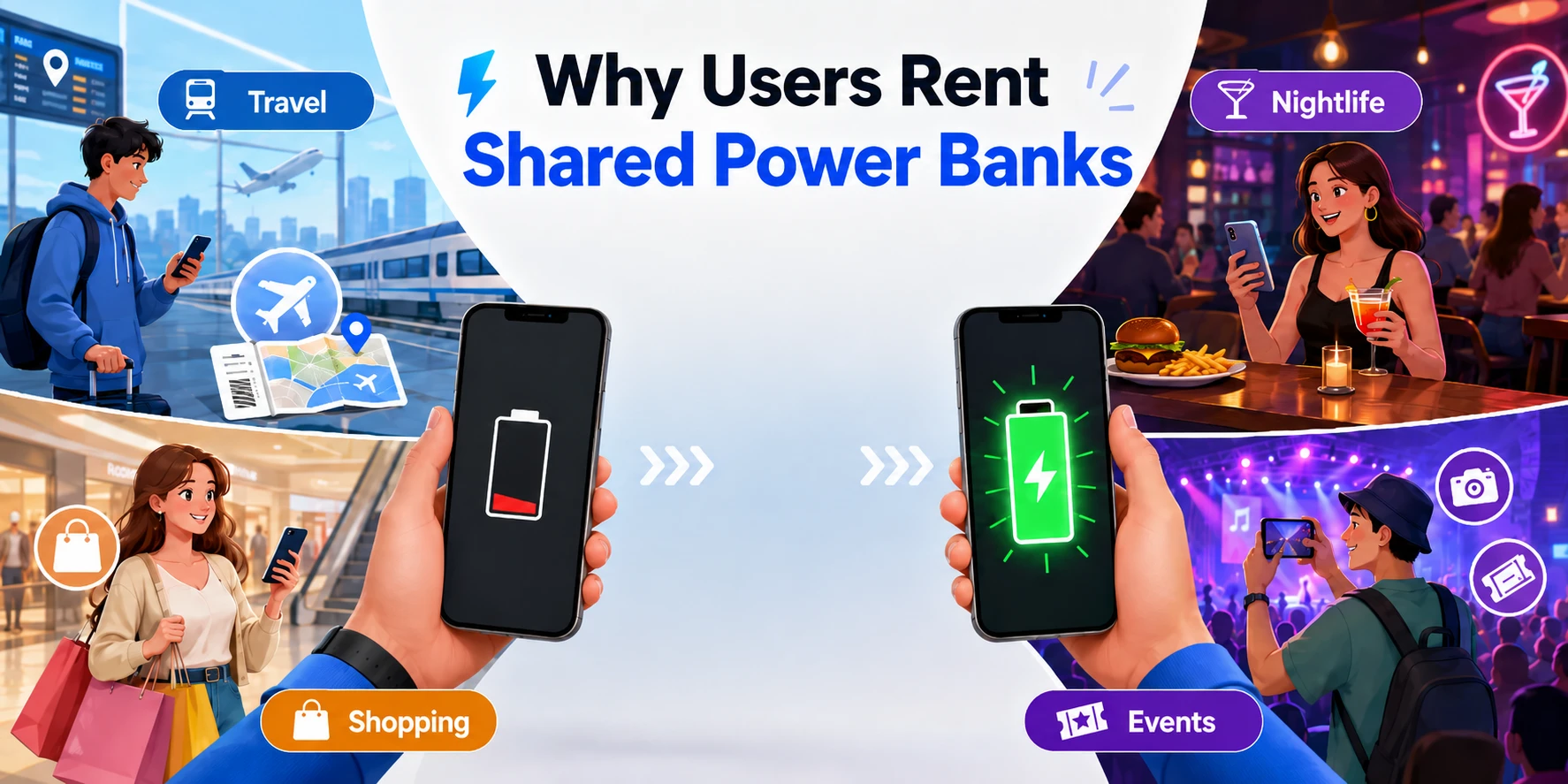
Users do not rent a power bank because they are interested in the device itself. They rent the ability to continue using their phone without being limited by a low battery.
Travel and transportation
At airports, railway stations, subway stations, and tourist destinations, users rely on phones for:
Boarding passes, Navigation, Hotel information, Mobile payments, Translation, Ride-hailing, Communication
Running out of battery can interrupt the entire journey. Portable charging is more convenient than waiting beside a fixed socket.
Restaurants and nightlife
In restaurants, cafés, bars, nightclubs, and entertainment venues, users often stay for long periods while taking photos, messaging, browsing social media, ordering, paying, or arranging transportation.
At night, battery anxiety can be stronger because users may need their phones to pay or travel home safely.
A visible phone charging kiosk can therefore improve customer experience while creating rental demand.
Shopping malls
Shopping mall visitors move between shops, restaurants, cinemas, and entertainment areas. Fixed charging points require users to remain in one place, while rental power banks let them continue shopping.
Events and festivals
Concerts, exhibitions, sports events, conferences, and outdoor festivals create concentrated charging demand.
Users take photos, record videos, livestream, access electronic tickets, and share content throughout the event. The longer the event lasts, the stronger the need for portable charging becomes.
The commercial value comes from solving a time-sensitive problem at the moment users are most willing to pay for convenience.
6. Shared Power Banks vs. Traditional Charging Services
Traditional charging services and shared power bank rentals solve similar problems but offer different user and business value.
| Comparison | Traditional Charging | Shared Power Bank Rental |
|---|---|---|
| Charging method | Fixed in one location | Mobile charging |
| User movement | User must wait nearby | User can continue moving |
| Revenue potential | Often free | Rental and advertising income |
| Coverage | Single location | Multi-location network |
| Data management | Limited | SaaS-based monitoring |
| Scalability | Low | Can expand citywide |
| Main value | Convenience facility | Operable rental business |
Traditional sockets or charging cabinets require users to remain nearby. In some cases, users must leave their phones inside a locker, which limits mobility and creates security concerns.
A rental power bank can be carried around. Users continue shopping, eating, travelling, or attending an event while charging.
Traditional charging is also often treated as a cost for the venue. Shared power banks can become a revenue-generating service through rental charges, advertising, and venue cooperation.
Another important difference is data.
A normal socket cannot show:How many people used it, When demand was highest, Which location performed best, Whether a device is offline, How much revenue was generated, Which power bank requires maintenance.
A shared rental system provides this information through its backend. Operators can use data to adjust prices, relocate stations, redistribute power banks, and improve network efficiency.
7. What Systems Are Required?
A complete shared power bank operation normally requires five connected systems.
Hardware system
The hardware system includes:Portable power banks, Rental stations, Charging modules, Electronic locks, Communication modules, Power management, NFC or QR modules, POS terminals, Advertising screens, Safety protection, Different locations require different equipment.
Small cafés, restaurants, and reception counters may use 4-slot or 8-slot desktop stations. Hotels, bars, hospitals, and entertainment venues may need 12-slot to 24-slot equipment. Airports, shopping malls, stations, and events may require 48-slot or larger floor-standing stations.
Outdoor deployments may also require waterproof and dust-resistant designs.
Payment system
The payment system must match local user habits.
European and North American markets may prioritize bank cards, contactless payments, Apple Pay, and Google Pay. Southeast Asian markets may rely more heavily on QR payments and local wallets. Other regions may require specific acquiring partners or local settlement methods.
Payment localization should be considered before ordering equipment. Adding it after deployment can be expensive and time-consuming.
Software system
The software platform normally includes: User rental pages, Operator backend, Merchant accounts, Order management, Pricing configuration, Payment records, Device monitoring, Revenue sharing, Fault alerts, Inventory reports, Advertising management. The system should support network growth rather than only the first few devices.
Operation system
Daily operations include:Venue development, Installation, Inspection, Device cleaning, Power bank redistribution, Fault handling, Customer service, Merchant communication, Pricing optimization, Performance review. Deployment is only the beginning. Stable operation determines whether the stations continue generating revenue.
Brand system
Local branding can increase user trust and venue cooperation.
Operators may customize:Device appearance, Logo and colors, Rental interface, App or H5 page,
Language, Pricing, Payment methods, Customer service information
A power bank rental station OEM solution allows operators to launch under their own brand without developing every part of the system from zero.
When choosing a shared power bank manufacturer, operators should evaluate hardware quality, software capability, payment integration, customization, technical support, spare parts, and long-term scalability rather than focusing only on price.
8. Is the Business Suitable for Every Market?
Not every market offers the same opportunity. Operators should evaluate several conditions before investing.
Smartphone dependence
The stronger the dependence on smartphones for payments, transport, navigation, communication, and entertainment, the greater the potential demand for emergency charging.
Density of suitable venues
The business performs better where there are many restaurants, malls, hotels, airports, bars, tourist attractions, hospitals, and event venues.
A large population alone is not enough. Operators need accessible offline locations where users stay long enough to experience low-battery anxiety.
Willingness to pay
Shared power banks are convenience services. Markets where consumers already pay for self-service, mobility, delivery, or small digital services may be easier to develop.
Local payment support
Users should be able to complete rentals using familiar payment methods. Operators must also consider refunds, pre-authorization, settlement cycles, transaction fees, currencies, and compliance.
Venue cooperation
The business depends on offline placement. Markets where venue owners are willing to accept revenue sharing, advertising cooperation, or customer-service partnerships are easier to scale.
Maintenance capability
Operators need a practical plan for: Device installation, Power bank redistribution, Fault repair, Spare parts, Customer complaints, Lost units, Offline equipment
A market may have strong demand but still be difficult to operate if maintenance costs are too high.
Before launching, operators should ask:Do people use their phones frequently outside the home?
Are there enough high-traffic venues?Will users pay for immediate charging?Can local payment methods be integrated?Are venue owners open to cooperation?Can the operator provide reliable maintenance?
If most answers are yes, the market has a stronger foundation for development.
9. The Real Value of the Business
The real value of shared power banks is not the charger itself. It is the ability to turn temporary charging demand into a repeatable and scalable local service.
Turning demand into transactions
Low battery is a common but scattered problem. Rental stations standardize the solution. Users find a station, pay, rent, and return through a consistent process.
Turning hardware into rental assets
Traditional hardware sales generate revenue once. Rental stations and power banks can generate revenue repeatedly when deployed in productive locations.
Building recurring income
As long as devices stay online, locations remain active, and users continue renting, the network can generate recurring orders.
Using data to improve performance
The SaaS backend helps operators identify:High-performing venues, Peak rental hours, Low-performing stations, Inventory shortages, Device faults, Revenue trends.This information supports better location selection, pricing, redistribution, and expansion decisions.
Building a local brand
White-label and OEM models allow operators to develop their own market identity, payment experience, language, pricing, and customer relationships.
The core business value can be summarized as:Mobile charging demand + venue network + automated payment + SaaS management + local brand operation
FAQ
What is a phone charging kiosk?
It is a self-service station that allows users to rent portable power banks. Users complete payment, take out a charger, use it while moving, and return it later.
How does power bank rental make money?
The main income comes from rental fees. Operators may also earn from overtime charges, advertising, membership services, software services, and venue cooperation.
Which locations are suitable?
Suitable locations normally have high foot traffic, long dwell times, and frequent smartphone use. Examples include airports, shopping malls, restaurants, bars, hotels, hospitals, universities, tourist attractions, exhibitions, and music festivals.
What equipment is needed?
Operators need rental stations, compatible power banks, payment integration, a user rental interface, SaaS management software, and maintenance support.
Can users return the power bank to another station?
Yes, provided the stations belong to the same compatible network and support cross-location returns.
Is a large station always better?
No. Capacity should match location demand. A café may only need a small desktop station, while an airport or shopping mall may require a large floor-standing unit.
Conclusion
The shared power bank business is a location-based portable charging rental network.
It is not simply about selling power banks or providing free charging. Operators deploy smart stations in suitable venues, allow users to rent and return portable chargers, and manage payments, orders, equipment, and revenue through a connected software system.
For users, the service solves an urgent low-battery problem.
For venues, it improves customer experience and may create additional income.
For operators, it provides a model that can be replicated across multiple locations and expanded into a local network.
Successful operation depends on more than buying inexpensive equipment. Operators should evaluate market demand, venue density, device quality, payment compatibility, software functions, maintenance, branding, and future scalability.
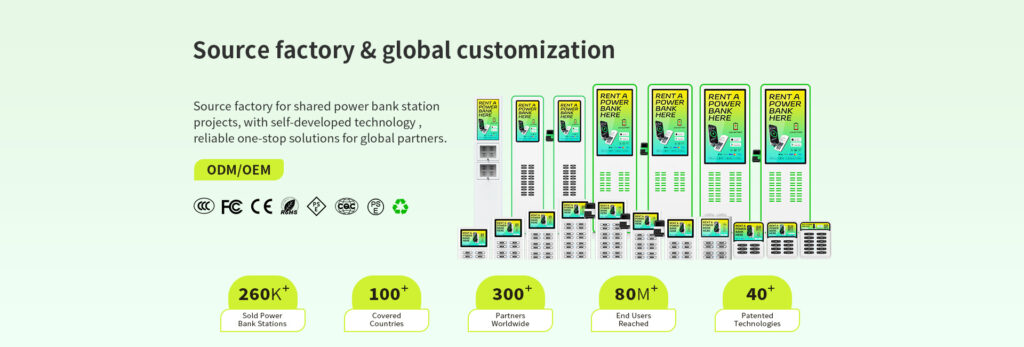
Bajie Charging provides shared power bank hardware, SaaS management software, payment integration, white-label branding, and OEM/ODM customization. Available solutions include desktop stations, floor-standing stations, advertising-screen equipment, NFC rental devices, POS-compatible stations, and outdoor models.
Operators can customize device appearance, rental interfaces, languages, payment methods, pricing, and backend functions according to their target market.
A reliable power bank rental solution should connect hardware, payment, software, venues, and local operations into one complete business loop. When these elements work together, shared charging becomes more than a convenience service—it becomes a sustainable local rental network.
Next Step
Planning to launch your own shared power bank network?
Provide your target country, deployment locations, preferred payment methods, and planned number of stations. we can recommend a suitable combination of hardware, software, payment integration, and brand customization.